
Drone Parts Affect the Overall Performance of a Drone
When a drone leaves the factory, all the parts are pristine and function optimally. But when the drone is used extensively, the components can wear out or be clogged with dust. This can decrease the overall performance of the drone and reduce flight times. Fortunately, many of these drone parts can be easily replaced or modified for better results.
One of the most important drone parts is the drone motor. These drone parts rotate the propellers, giving the UAV lift and control in flight. The motor is powered by a battery, which can be upgraded for longer flight times. Drones are built with different types of batteries, each designed for their specific purpose. Some are lithium polymer (LiPo) while others are nickel-metal hydride (NiMH). LiPo batteries are most commonly used in consumer drones as they offer more capacity for the same weight, while NiMH batteries have higher energy density.
While the drone parts acts as the skeleton, it also provides support for all the other parts. The frame is made from lightweight materials such as plastic or carbon fiber to keep the weight low and ensure strength. It further protects drone parts like the main board, processors avionics, cameras, sensors and batteries.
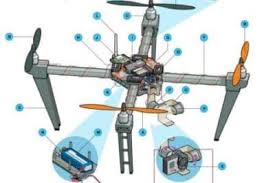
How Do Different Drone Parts Affect the Overall Performance of a Drone?
The drone’s main board is considered the brain of the UAV. It is responsible for processing the data from all the drone parts and sending it to the pilot’s controller. It is also capable of transmitting commands from the controller to the drone and vice versa.
A drone can be fitted with various types of sensors to create a complete picture of its environment and make intelligent decisions while in flight. Some of these sensors include 3D mapping using Lidar and thermal vision, collision avoidance with Monocular Vision, Ultrasonic (Sonar) and Infrared, and time-of-flight and lidar sensors for navigation. Some of these sensors can be used for automated flying, allowing the drone to perform more complex tasks without the need for human intervention. In this way, drones can save valuable resources such as time and money.
When a drone is carrying more payload, it needs to produce more lift in order to stay airborne. This requires the drone to spin its propellers faster, which in turn draws more power from the battery. This limits flight times, especially if the drone is navigating rough terrain or has to carry a heavier camera for aerial mapping.
Drone motors can be categorized into two kinds – brushed and brushless DC. Brushed motors use mechanical systems including brushes and a commutator to transfer current, whereas brushless DC motors utilize electronic mechanisms. Both have their advantages, but the latter is more popular as it is lighter, more efficient and quieter. It is also possible to reverse the rotation of a drone’s motors by swapping the two wires connected to its ESC, allowing the pilot to tailor the motor behavior for specific conditions or preferences. The ESC is also responsible for controlling the drone’s speed and direction, ensuring stability and orientation.

+ There are no comments
Add yours