
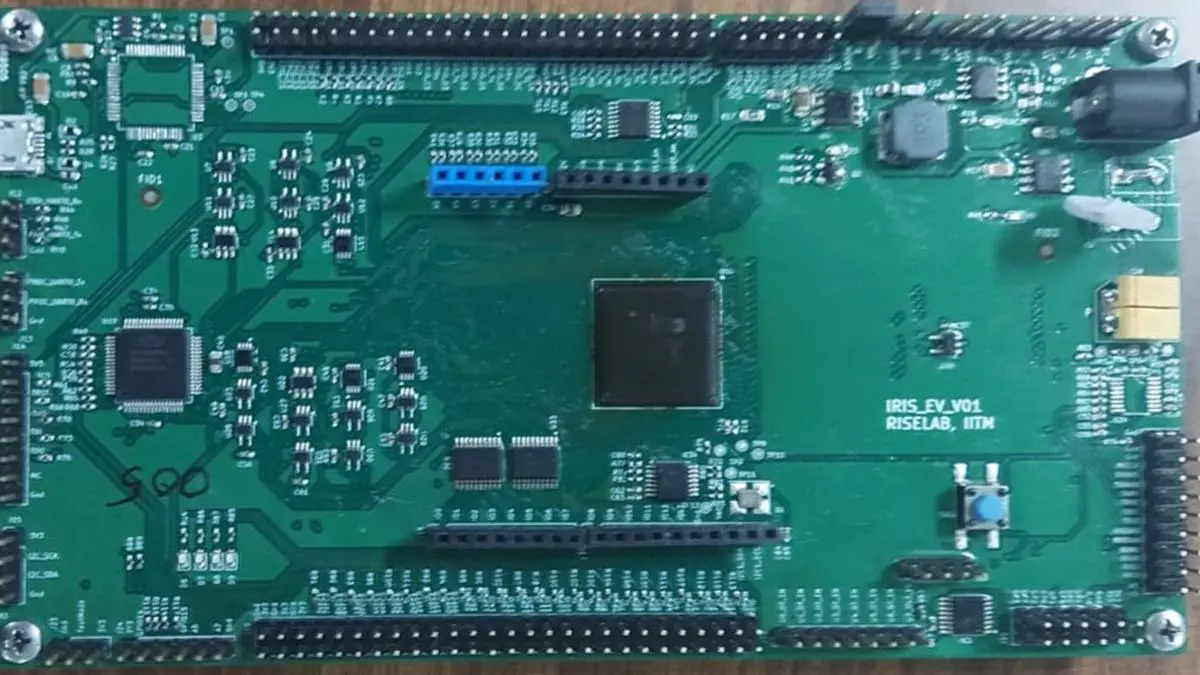
Indian Institute of Technology Madras (IIT Madras) and Indian Space Research Organisation (ISRO) have led the way in developing and successfully booting an Atmanirbhar aerospace quality SHAKTI-based semiconductor chip. The project aims to promote indigenous development of microprocessor-based products that offer best-in-class security and visibility for users adopting RISC-V technology, an open-source Instruction Set Architecture (ISA), for designing custom processors.
The SHAKTI microprocessor project was led by V. Kamakoti at Prathap Subrahmanyam Centre for Digital Intelligence and Secure Hardware Architecture in the Department of Computer Science and Engineering, IIT Madras. It is backed by the Union Ministry of Electronics and Information Technology under its ‘Digital India RISC-V’ initiative.
The ‘IRIS’ (Indigenous RISCV Controller for Space Applications) chip was developed from ‘SHAKTI’ processor baseline. It can be used in diverse domains from Internet of Things and compute systems for strategic needs. This development was part of the effort to indigenise semiconductors used by ISRO for its applications, Command and Control Systems and other critical functions aligning with its march towards ‘Atmanirbhar Bharat’ in Space Technologies, says a release.
The ‘IRIS-LV 1.0’ Semiconductor Chip developed by IIT Madras for ISRO
| Photo Credit: supplied
The ISRO Inertial Systems Unit (IISU) in Thiruvananthapuram proposed the idea of a 64bit RISC-V-based Controller and collaborated with IIT Madras in defining the specifications and designing of the semiconductor chip. The chip configuration was arrived at addressing the common functional and computing requirements of existing sensors and systems used in ISRO missions. Fault-tolerant internal memories were interfaced to SHAKTI core, enhancing the reliability of the design.
- Read: India launches OALP X at IEW; invites foreign investors
This semiconductor conceived by IISU Thiruvananthapuram, designed and implemented by IIT Madras, manufactured by SCL, Chandigarh; packaged by Tata Advanced Systems, Ltd at Perjenahalli, Karnataka; Motherboard PCB (Printed Circuit Board) manufactured by PCB Power, Gujarat; motherboard assembled and mounted by Syrma SGS, Chennai and the software developed by IIT Madras and successfully booted at IIT Madras.
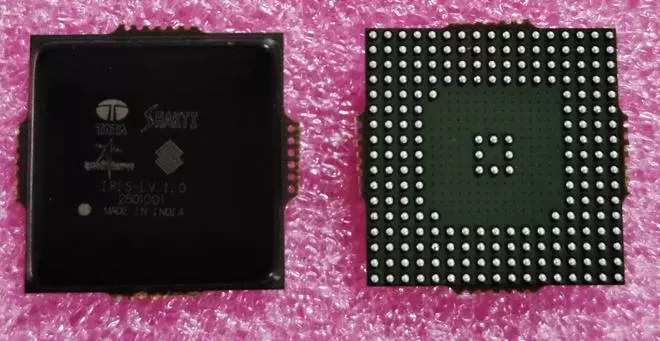
The ‘IRIS-LV 1.0’ Semiconductor Chip developed by IIT Madras for ISRO
| Photo Credit:
Highlighting the importance of this new microprocessor, V. Kamakoti, Director, IIT Madras, said, “After RIMO in 2018 and MOUSHIK in 2020, this is the third SHAKTI chip we have fabricated at SCL Chandigarh and successfully booted at IIT Madras. That the chip design, chip fabrication, chip packaging, motherboard design and fabrication, assembly, software and boot – all happened inside India, is yet another validation that the complete semiconductor ecosystem and expertise exists within our country.”
- Read also: Govt planning to use AI for identifying mule accounts to check cybercrime: Amit Shah
V Narayanan, Chairman, ISRO, said, “We at ISRO are very happy that the IRIS Controller conceived by IISU based on the SHAKTI processor of IIT Madras could be successfully developed end-to-end with Indian resources. This marks truly a milestone in “Make in India” efforts in semiconductor design and fabrication. It is planned to flight test a product based on this controller shortly and performance will be confirmed.”



+ There are no comments
Add yours